

Home training can be convenient and effective. An HDB flat may support bodyweight exercise, resistance bands, adjustable dumbbells and mobility work. These options can maintain activity without travelling to another location.
A dedicated fitness gym singapore facility provides a different training environment. Its value is not simply that it contains more equipment. It offers load capacity, specialised resistance profiles, space and support systems that are difficult to reproduce in a multipurpose home.
Greater Loading Range
Home equipment usually has a practical weight limit. Adjustable dumbbells can cover many exercises, but lower-body strength may eventually exceed the available resistance.
The legs and hips can tolerate substantial loading. When home weights become too light, the person may add repetitions, slow tempo or use single-leg variations.
These methods are valid, but they change the training demand. Someone seeking progressive external loading may need heavier equipment.
A gym provides barbells, plates and machines with broader resistance ranges. It also allows smaller increases between sessions.
Specialised Resistance Profiles
Resistance bands, dumbbells and bodyweight exercises create particular loading patterns. Machines and cables can provide different challenges through a movement.
A leg curl directly trains knee flexion in a way that is awkward to reproduce with a basic home setup. Cable equipment allows resistance to be applied from different directions.
Specialised machines are not essential for everyone. They become useful when the programme requires additional volume or a movement that free weights do not provide conveniently.
A gym makes these options available without requiring the member to purchase and store each machine.
Stable Support for Targeted Training
Home exercises often require the person to create stability. This can be valuable, but it may also prevent the target muscles from receiving enough work.
A supported gym machine can reduce balance and trunk demands. The member may then concentrate on producing force through the intended movement.
Stable equipment can also help later in a session when general fatigue is high. The person can continue targeted work without holding a difficult unsupported position.
This is one reason home and gym exercises should not be compared only by which muscles they use.
Equipment Granularity
Progression works best when difficulty can increase gradually.
Home equipment may offer only a few resistance settings. Moving to the next option can create a large jump, particularly for upper-body exercises.
Gym weight stacks and plate combinations often provide more intermediate steps. Dumbbell racks may also cover a wider range.
This granularity allows members to progress without changing the exercise every time the available weight becomes too easy.
Space for Full Movement
HDB living spaces serve many purposes. Furniture, storage and household activity limit the area available for training.
Some exercises require more clearance than expected. Lunges, loaded carries and cable movements need space in several directions.
Ceiling height can restrict overhead work. Long resistance bands require secure attachment points, while benches take up floor space even when not in use.
A gym provides designated exercise areas. Members can perform wider movements without reorganising a living room.
Noise and Vibration Management
Jumping and placing weights on the floor can transmit noise through an apartment building. Even careful users must consider neighbours and household members.
This restricts high-impact conditioning and certain loaded exercises. Thick mats may help, but they cannot eliminate all vibration.
Commercial gyms are designed to accommodate greater activity. Flooring and equipment zones provide a more suitable environment for weights and dynamic movement.
Members still need to follow etiquette and avoid dropping equipment unnecessarily. The difference is that the space is intended for exercise.
Safety Infrastructure
Heavy resistance training requires more than weights. Racks, safety arms, stable benches and clear floor space contribute to setup.
Installing this infrastructure at home requires substantial room and investment. Equipment must also be maintained.
A gym provides shared access to these resources. Members can use different stations without owning them permanently.
Safety still depends on technique and sensible loading. Infrastructure supports good practice but does not replace it.
Cardio Equipment Without Weather Dependence
Singapore’s heat, humidity and rain can make outdoor cardio unpredictable. Home cardio machines require space, create noise and involve maintenance.
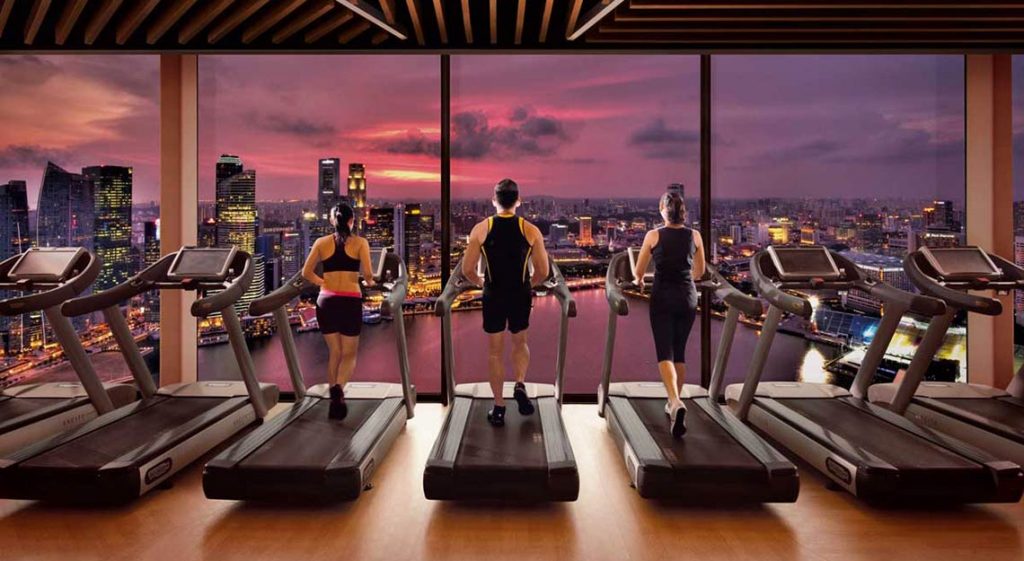
A gym provides treadmills, bikes and other equipment in a controlled indoor environment. Members can repeat pace, resistance and interval structures regardless of weather.
Outdoor activity remains valuable. Gym cardio is another option when conditions or scheduling make outdoor training difficult.
The advantage is consistency rather than superiority.
Classes and Instructor-Led Structure
A home workout depends on personal planning and motivation. Digital instruction can help, but it does not fully reproduce a live class environment.
Instructor-led sessions provide a set time, shared pace and immediate exercise options. The social environment can also improve adherence for people who enjoy training with others.
Classes should still match the member’s ability and weekly workload. Attending more sessions is not always better.
A gym makes structured group exercise available without requiring the home to become a studio.
Access to Personal Guidance
Online information is abundant, but applying it to an individual programme can be difficult.
Personal trainers can observe technique, organise progression and adjust exercises according to the member’s goals. This is a different service from following a general video.
Coaching is not necessary for every session. It can be useful when someone needs assessment, accountability or help moving beyond a long-standing plateau.
At True Fitness Singapore, members can combine gym equipment with classes and personal-training options. This creates a training system that is difficult to reproduce through equipment purchases alone.
Maintenance and Storage Are Shared
Home equipment must be purchased, stored and maintained by the user. A machine that breaks may remain unusable until the owner arranges repair.
A gym distributes these responsibilities across the facility. Members arrive, use the equipment and leave without storing it in their living space.
This convenience is easy to overlook. A large home setup can reduce the flexibility of a room and create ongoing maintenance needs.
The membership price partly pays for access without ownership.
Home Training Still Has an Important Role
The strengths of a gym do not make home exercise irrelevant.
Home sessions can support mobility, short workouts and activity during busy days. They remove travel and make it easier to complete small amounts of movement.
A hybrid plan may use the gym for heavier resistance, machines and classes, while the home supports lighter work.
This division gives each environment a suitable role.
Dedicated Infrastructure Is the Main Difference
An HDB home can support effective exercise, but it remains a living environment. Space, storage and noise place natural limits on what it can contain.
A fitness gym provides shared infrastructure at a scale that most homes cannot justify. Heavy loads, specialised machines, cardio equipment, safety systems and coaching become accessible in one place.
The choice is not about declaring one environment better. It is about matching the environment to the goal. Home training offers convenience, while a dedicated gym provides progression options and resources that cannot be replicated easily inside an HDB flat.

Comments are closed.